
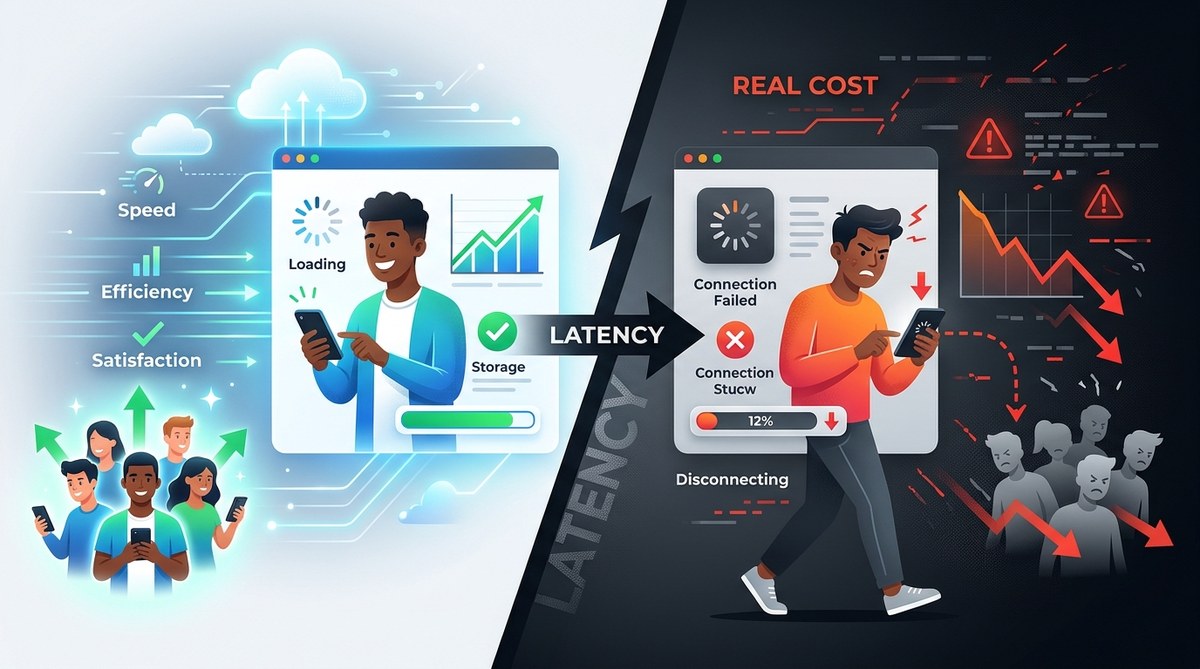
Every time a user clicks download and waits, your product loses a little more trust. That spinning wheel or stalled progress bar does not just test patience. It directly affects your bottom line. For cloud infrastructure managers and product owners, the cost of file hosting latency on user retention is one of the most overlooked drains on revenue. A 100 millisecond delay can slash conversion rates by 7 percent. For a SaaS platform handling millions of file transfers a month, that delay translates into thousands of lost users and tens of thousands in missed revenue. The real price is not just the cloud bill. It is the cumulative effect of every frustrated user who walks away.
Latency in file hosting is not just a technical metric. It is a customer retention problem with a direct financial cost. Even small delays cause measurable churn, especially for mobile users. The hidden expenses include lost recurring revenue, higher support costs, and wasted infrastructure spend. By measuring latency against user behavior and optimizing storage architecture, you can reduce churn by up to 20 percent and improve your cloud ROI.
The Connection Between Speed and User Loyalty
Users expect files to load almost instantly. Whether it is a PDF from a document management system, a high-res image from a design tool, or a software update from a distribution platform, the tolerance for slow downloads has shrunk. Research from Google shows that 53 percent of mobile users will abandon a site if it takes longer than three seconds to load. File hosting latency works the same way. If a download takes more than a couple of seconds, users leave.
The problem compounds. A user who leaves once might come back. A user who leaves twice or three times starts to associate your brand with slowness. Eventually, they switch to a competitor. That is the hidden cost of file hosting latency on user retention. It is a slow bleed that is hard to measure until you look at monthly churn reports.
Why Latency Hurts More in 2026
Bandwidth and edge computing have improved globally, but user expectations have risen even faster. In 2026, people stream 4K video, join video calls with zero noticeable lag, and download gigabyte files in seconds over fiber. When your file hosting does not meet that bar, it stands out. Worse, the gap between your slowest users and your fastest users is widening. A user in a rural area with a 5 Mbps connection will feel latency far more acutely than someone in a city with gigabit fiber. If you optimize only for your fastest users, you are silently churning your entire long-tail audience.
Breaking Down the Real Cost
The cost of file hosting latency on user retention is not a single line item. It shows up in several places on your balance sheet. Here are the main categories to watch.
- Lost recurring revenue. A churned user stops paying their monthly subscription. If your average revenue per user is $50 and you lose 500 users a year due to slow downloads, that is $25,000 in direct lost revenue. And that number grows every year as your user base grows.
- Higher support costs. Users who encounter slow downloads open tickets. They complain on social media. They post in community forums. Each support interaction costs your team time and money. Slow file hosting can double your support volume for download-related issues.
- Wasted infrastructure spend. You might be paying for premium cloud storage or CDN bandwidth that is not configured correctly. The money goes out, but the speed does not improve. You are essentially burning cash on latency you could fix with better architecture.
- Damage to brand reputation. Users talk. A reputation for being slow is hard to shake. Even after you fix the issue, the memory of waiting lingers. This indirect cost can take months or years to reverse.
A Real-World Example
Consider a file sharing platform that hosts large design files. Their average download speed for a 50 MB file is 4 seconds on desktop but 12 seconds on mobile. They run a test: they optimize their mobile delivery path using edge caching and reduce that time to 3 seconds. The result is a 15 percent reduction in mobile churn over the next quarter. That single change saves them over $40,000 in annual recurring revenue. The cost of the optimization was a few hundred dollars in engineering time and a modest increase in CDN usage.
How to Measure Latency Impact on Retention
You cannot fix what you do not measure. To understand the cost of file hosting latency on user retention in your own system, follow this process.
- Instrument your download paths. Add timing metrics to every file download. Track the time from request to first byte (TTFB) and total download time. Store these alongside user IDs and device types.
- Segment your user base by speed. Group users into buckets based on their average download time: under 1 second, 1 to 3 seconds, 3 to 5 seconds, and over 5 seconds.
- Compare churn rates across buckets. Look at your 30 day and 90 day retention for each group. You will almost certainly see a clear correlation. Users in the slowest bucket will churn at a much higher rate.
- Calculate the dollar impact. Multiply the churn difference between your fastest and slowest buckets by your average revenue per user. That number is the direct cost of latency for your business.
“We found that users who waited more than 5 seconds for a file download churned at 3 times the rate of users who waited under 1 second. That single insight drove our entire infrastructure rearchitecture.” — Infrastructure Lead at a major cloud storage provider
Common Mistakes That Amplify Latency
Many teams unknowingly make their latency problem worse. Here are the most common errors and the better approach.
| Mistake | Why It Hurts | Better Approach |
|---|---|---|
| Serving all files from a single origin server | Creates a single point of failure and forces long distances for remote users | Use a CDN with multiple edge points to serve files from the closest location |
| Not compressing files before delivery | Larger files take longer to transfer, especially on slower connections | Enable gzip or Brotli compression for text based files and optimize images |
| Ignoring mobile user experience | Mobile networks are slower and more variable than wired ones | Implement adaptive delivery that adjusts file quality based on connection speed |
| Using expensive cloud storage for hot files | Hot files cost more to serve from high tier storage and still have latency | Move frequently accessed files to a CDN or edge cache with lower latency |
| Not monitoring latency by region | Averages hide problems. Users in one region might suffer while others are fine | Set up per region latency dashboards and alert on outliers |
Optimizing Your Infrastructure to Reduce Churn
Reducing the cost of file hosting latency on user retention does not require a complete rebuild. Small, targeted changes can have an outsized impact. Here are the most effective strategies.
Use Edge Caching and CDNs
A content delivery network places copies of your files on servers around the world. When a user requests a file, they get it from the nearest edge node instead of your origin server. This can cut download times by 50 to 80 percent for users far from your main data center. For global products, a CDN is not optional. It is the single most effective way to reduce latency.
Optimize File Sizes
Large files are the biggest contributors to high latency. Before you blame your infrastructure, look at your file sizes. Are you storing uncompressed images or raw video files? Can you offer lower resolution previews for users on slow connections? Reducing file size by even 20 percent can dramatically improve download times for mobile users.
Implement Chunked Uploads and Resumable Downloads
For large file hosting, allow users to download in chunks. If a connection drops, they can resume from where they left off instead of starting over. This reduces the perceived latency because the first chunk arrives quickly. It also improves the user experience for those on unstable connections.
Choose the Right Storage Tier
Not all files need to be on high performance SSDs. Old files, archived data, and rarely accessed content can live on slower, cheaper storage without affecting the user experience. Move your hot files to fast storage or a CDN. Keep cold files on object storage with higher latency. This balances cost and performance.
Building a Latency Aware Retention Strategy
The cost of file hosting latency on user retention is not static. It changes as your user base grows and as your product evolves. To stay ahead, build a strategy that treats latency as a core product metric, not just an infrastructure concern.
- Set a latency budget for each user segment. For example, mobile users in emerging markets should not wait more than 3 seconds for a file download.
- Run regular speed tests using real user monitoring tools. Synthetic tests from data centers do not capture the real experience of your users.
- Tie latency improvements to retention goals. When you reduce average download time by 1 second, project the expected reduction in churn and track it.
- Communicate latency improvements to your users. If you make a big optimization, tell them. It rebuilds trust and reminds them that you care about their experience.
The Forgotten Factor: Upload Latency
Most discussions focus on download speed, but upload latency matters just as much for retention. If a user tries to share a file and the upload takes forever, they will abandon the process. That is a lost action, and often a lost user. Optimizing upload paths with parallel chunking and smart retry logic can improve completion rates by 30 percent or more. Do not ignore the other half of the equation.
Why Your Cloud Bill Is Not the Real Cost
When cloud infrastructure managers look at their monthly bill, they focus on storage and bandwidth charges. But the cost of file hosting latency on user retention is often larger than the entire cloud bill. A user who churns because of slow downloads does not just stop paying. They also tell their colleagues, post negative reviews, and choose a competitor for their next project. That ripple effect multiplies the loss.
Think of it this way. If your cloud bill is $10,000 a month and you lose $15,000 a month in revenue from churn caused by latency, you are actually losing money on your infrastructure. The solution is not to cut the cloud bill. It is to spend a little more on the right architecture to keep users happy. The math works out in your favor.
Start Measuring and Optimizing Today
The cost of file hosting latency on user retention is real, measurable, and fixable. You already have the data. Your download logs, your churn reports, and your support tickets all tell the story. The question is whether you will listen to them.
Start by running the measurement process outlined above. Identify your worst latency buckets. Apply one or two of the optimizations we covered. Then measure again. You will see the impact in your retention numbers within a month or two. Your users will notice the difference. And your revenue will reflect it.
For a deeper look at how to choose the right storage architecture for your needs, check out our guide to choosing the best cloud storage for digital files. If you want to understand the specific technical benchmarks that matter, read our piece on file hosting performance benchmarks every developer should test in 2026.
Turning Latency Into a Competitive Advantage
Most products treat latency as a cost to minimize. The smartest teams treat it as a differentiator. When you make file hosting fast and reliable, users notice. They tell others. They trust your product more. That trust translates into higher retention, lower churn, and a stronger brand.
The cost of file hosting latency on user retention is high. But the opportunity cost of ignoring it is even higher. In 2026, speed is not a feature. It is the price of entry. Make sure your file hosting meets that standard, and your users will reward you with their loyalty.